
One of the critical aspects of navigating technological change effectively is understanding more about how users accept and adopt new technologies. For leaders trying to drive technology acceptance and adoption, and to introduce new ways of working within organisations, or consultants and strategists looking to understand changing contexts and capabilities, it can be really useful to think about how and why new technology is adopted or not adopted. Not least because with AI, we are in the midst of significant technological-driven change right now.
This thought has led me down a few rabbit holes on technology acceptance recently, and since writing helps to organise my thinking, this has provided the motivation for me writing up a few thoughts here. There’s a number of technology adoption models knocking about and a few in particular which have built on each other over time in a way that provides a really helpful way of understanding technology acceptance.
Theory of Planned Behaviour (TPB)
First, the Theory of Planned Behaviour (Ajzen, 1985), which builds from the the Theory of Reasoned Action (TRA). The TRA basically suggests that a person’s behavioural intention is an essential factor in determining their behaviour, and that this intention can be influenced by attitude and subjective norms (a person’s perception of how others would feel about them engaging in a specific behaviour). The TPB introduces the idea that behaviour is not only influenced by attitudes and social norms but also by a person’s perception of the ease or difficulty of performing a specific task (so called Perceived Behavioural Control). So with the adoption of new technology it is subjective norms, attitude and perceived behavioural control that is important.

TPB provides a good foundation for the models that came after it.
Technology Acceptance Model (TAM)

Four years after TPB came the Technology Acceptance Model (TAM) (Davis and Davis et al, 1989) which was originally proposed in response to concerns that employees were not using the IT that was available to them. It’s based on the idea that a person’s beliefs, attitudes, and intentions can explain their adoption and use of technology and so it builds from the TPB and TRA. But it suggests that the critical factors that influence an individual’s intention to use new technology are perceived ease of use and perceived usefulness.
Perceived usefulness (PU) reflects the degree to which an individual believes that using technology will enhance their job performance and has consistently been found to be the strongest predictor of technology usage intentions. Perceived Ease of Use (PEOU) refers to how effortless a person believes using a particular technology will be, and this can work alongside PU since ease of use leads to higher perceived usefulness. Later versions of TAM introduced a few additional factors to give more nuance to the predictive power of the model. These included subjective norms, job relevance, and result demonstrability amongst others.
TAM was used for a number of years across various industries to help predict and shape technology adoption behaviours. But critics have argued that its weaknesses derived from its simplicity – specifically that it didn’t take into account technology-specific variables (like compatibility and system design) and that it focused on user acceptance to the detriment of considering the performance impact of the new technology.
Which brings us to UTAUT.
Unified Theory of Acceptance and Use of Technology (UTAUT)
The UTAUT model (Venkatesh et al, 2003), integrates elements from both TAM and TPB but focuses on four key constructs that influence technology adoption: Performance Expectancy, Effort Expectancy, Social Influence, and Facilitating Conditions (seen on the left of the diagram below). It also incorporates moderators like age, gender, experience, and voluntariness to explain variations in user behaviour across different groups (seen across the bottom of the diagram).
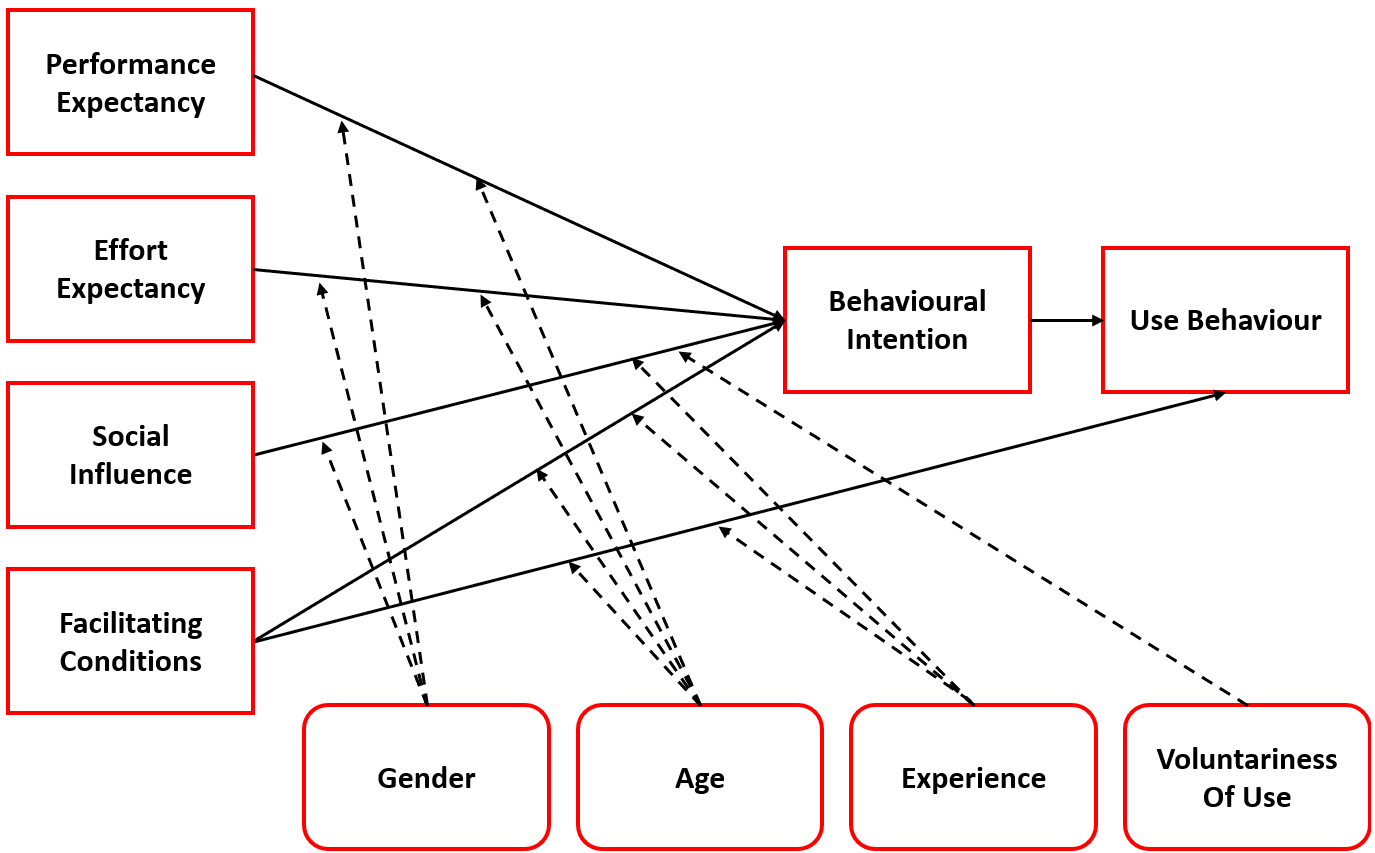
UTAUT is useful since it can help us to understand and predict user intentions and behavior during the implementation of new technologies and systems. But it can also inform strategies that can encourage adoption, reduce resistance and foster a more technology-friendly environment. For example, we can leverage each of the four constructs on the left of the diagram:
1. Performance Expectancy (PE): this is closely aligned with the perceived usefulness in the TAM model and relates to the degree to which individuals believe that using a system will help them attain gains in job performance. So here, productive tactics might include highlighting tangible and job relevant benefits, demonstrating how using the technology can realise company and team goals, and using early success stories, measurable impacts and relevant examples that show how the technology has driven success.
2. Effort Expectancy (EE): this relates more closely to the Perceived Ease of Use (PEOU) in the TAM model. Here the simplicity and intuitiveness of user interfaces (technologies that require minimal effort to learn and use) is key. Unnecessary complexity presents a barrier to adoption so proper training and visible ongoing support are important, and a step-by-step roll out or pilot-based approach can help people to feel more comfortable with it.
3. Social influence (SI): this captures the extent to which individuals perceive that important others (like peers, supervisors, or influencers) believe they should use the new technology. This is about developing common knowledge as a force for changing behavioural norms. Internal champions and early adopters can be useful ways to show the way forwards. But also strong, visible support from senior leaders (and where appropriate use of the new technology) can ensure top-down endorsement and modelling of behaviour. Team-based peer influence incentives may also help create a positive social pressure for change.
4. Facilitating Conditions (FC): This refers to the degree to which individuals believe that there is a solid organisational and technical infrastructure to support the use of the technology. It sounds obvious but properly thinking through the necessary infrastructure, tools and resources that will be needed to ensure that performance is good from the start will ensure that the system is not dead on arrival. Practical things like troubleshooting support, regular progress updates and the ability to track feedback and adapt where necessary can make it much more likely that people will shift their approaches earlier.
So why is this important? Technology change is, in the end, so much about people. And if we fail to account for the people side of change then acceptance and adoption of new technology will itself fail. So taking UTAUT as inspiration, here’s a simple way of articulating an approach for successful technology acceptance and adoption:
- A clear vision and roadmap that communicates value and benefits (Performance Expectancy): Executives need to communicate the vision for why the technology is being adopted and the roadmap for implementation. Transparency around strategic context (how this technology will help deliver the business strategy), timelines, expectations, and outcomes (improvements in job performance or results) will help alleviate concerns and give people a reason to change. Practical demonstrations and success stories can be used to show the benefits.
- Simplifying access and training (Effort Expectancy): making it as easy as possible for employees to engage in the technology in a supported and safe to fail way. Hands-on training, tutorials, user guides, demonstrations (people learn in different ways) combined with real-time support. The aim here is to build not just competence but confidence.
- Creating catalsyts for change (Social Influence): Identifying early adopters or influencers within the organisation and then positioning them as champions for the new technology can drive a ‘show not tell’ approach to change. Leaders modelling the right behaviours (expectations, using the technology themselves) can super-charge other forms of social influence. Making adoption and benefits more visible in this way can combine peer encouragement and executive endorsement to create powerful new subjective and social norms.
- Building a supportive environment (Facilitating Conditions): This encompasses both ensuring the right technical infrastructure is in place from the start and also that ongoing resources are allocated for operational running and support. It feels self-evident that it has to provide value from the beginning but the back-end systems thinking needed to make this seem seamless is often neglected.
- Rewarding adoption and tracking success (Measure & Incentivise): it should go without saying that the introduction of new technology at scale requires clear goals, and measurable KPIs so that progress can be tracked and tactics adapted. Rewarding staff that effectively integrate the technology into their workflows can be as simple as recognition of early successes by senior leadership but team incentives can also help. Sharing further successes and celebrating wins on an ongoing basis can help build momentum
When technology is becoming so elemental to every function but is also changing so fast, understanding technology acceptance and adoption has become more important than ever.
I write a weekly Substack of digital trends, transformation insights and quirkiness. To join our community of thousands of subscribers you can sign up to that here.
To get posts like this delivered straight to your inbox, drop your email into the box below.


Leave a Reply