

‘Best practice’ is one of those terms that whilst not inherently bad has become so overused as to be stretched beyond its rightful application. So it gets applied generically to any scenario where an understanding of the most effective methods to solve a problem are desired. Our wish to create certainty out of ambiguity, and to impose control over the unpredictable leads us to wish to standardise approaches and apply best practice to many distinct types of situation. But as we know there are different types of problem in the world and there is a big difference between simple, complicated and complex challenges.
So it’s worth reminding ourselves of Dave Snowden’s framework for decision making and his Cynefin model.

Image: Tom@thomasbcox.com, CC BY-SA 4.0
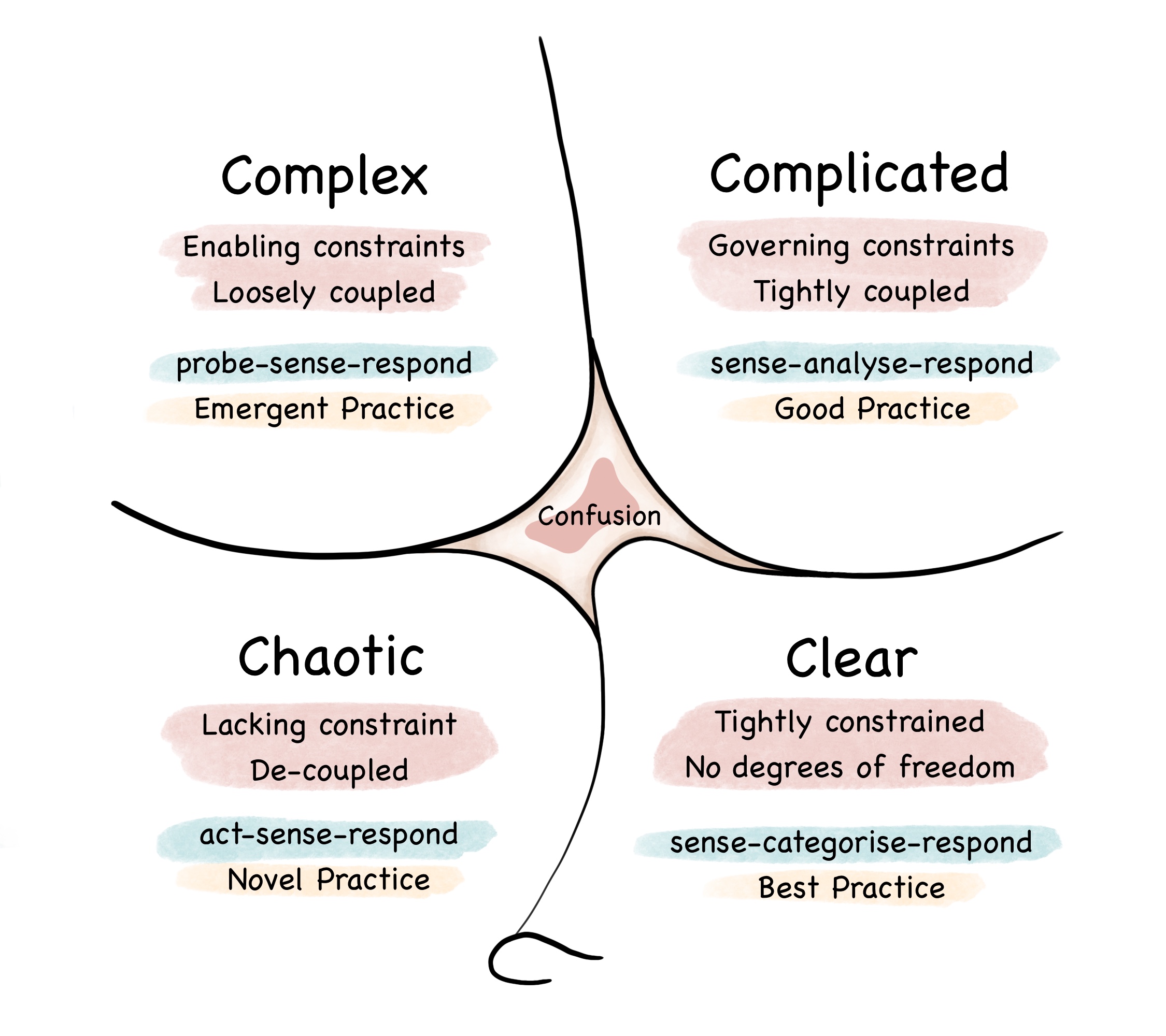
Simple contexts, characterised by stable, clear cause and effect relationships and ‘known knowns’ are the domain of best practice. Managers, says Dave, might appraise a situation and base a response on established processes. The hazards here come from complacency and entrained thinking which might blind us to new perspectives.
Complicated contexts may still have a clear relationship between cause and effect but can also contain many applicable answers, some of which are not not immediately obvious (‘known unknowns’), and so this requires analysis of suitable options and is typically the domain of experts. Good practice is therefore more appropriate than best practice. The danger in this context comes from experts who are biased towards preferred solutions, over-analysis leading to paralysis, or from ignoring potentially innovative ideas from non-experts.
Complex contexts however, are constantly shifting (‘unknown unknowns’). The temptation in the face of such unpredictability, says Dave, is to demand certainty in the form of fool-proof plans with precise outcomes. To revert to a command-and-control leadership style. To become less patient. But in complex contexts we can only understand why things happen in retrospect and answers are emergent so we need to look for instructive patterns through experimentation. Encouraging the conducting of experiments that are as ‘safe to fail’ as they can be enables informative patterns and a clearer direction to emerge. Imposing a desire for order or a rigidly defined course of action will preempt the opportunity for such instructive patterns to emerge.
In chaotic contexts no manageable patterns exist, the relationship between cause and effect are impossible to define, and so clear, concise and immediate action to establish as much order and stability as possible is what is required. Leaders need to work to transform situations from chaos to complexity where emerging patterns might be identified and suitable responses determined.
The relevance of this is that as we all know the world of business is increasingly characterised by uncertainty, continuous flux and complex contexts. The bad side of best practice is that we seek to over-simplify and use it as a way of seeking certainty in situations that require a more emergent pattern of decision-making.
The ‘streetlight effect’ (which I mentioned in passing before) is an observational bias that leads us to look for answers in the easiest places. Like the old joke…
‘A policeman sees a drunk man searching for something under a streetlight and asks what the drunk has lost. He says he lost his keys and they both look under the streetlight together. After a few minutes the policeman asks if he is sure he lost them here, and the drunk replies, no, and that he lost them in the park. The policeman asks why he is searching here, and the drunk replies, “this is where the light is.”‘
As Dave notes, best practice is, by definition, past practice but hindsight no longer leads to foresight after a shift in context. Whilst it may be appropriate in simple contexts, misappropriation of best practice in todays ever-more complex world means that we are in danger of becoming the drunk searching for his keys in the streetlight.
I write a weekly Substack of digital trends, transformation insights and quirkiness. To join our community of thousands of subscribers you can sign up to that here.
Photo by Artem Kovalev on Unsplash
Leave a Reply