

This week, after first reading it several years ago, I was prompted to return to Chris Dixon’s wonderful post about climbing the wrong hill. The term comes originally from computer science, but to illustrate it he uses the example of a young, smart graduate who works on Wall Street and is considering staying despite hating the industry and having longer term ambitions to work at a start up:
‘A classic problem in computer science is hill climbing. Imagine you are dropped at a random spot on a hilly terrain, where you can only see a few feet in each direction (assume it’s foggy or something). The goal is to get to the highest hill.
Consider the simplest algorithm. At any given moment, take a step in the direction that takes you higher. The risk with this method is if you happen to start near the lower hill, you’ll end up at the top of that lower hill, not the top of the tallest hill.’
For this graduate the lure of the current hill is strong. He is being offered more money and more responsibility to stay. The natural tendency, particularly for the ambitious, is to keep moving upwards on the current path. But he is climbing the wrong hill.
In my third book on Agile Marketing I talk about ‘local’ and ‘global’ maximums. It’s the same idea. Local maximums are the limits of where you can get to based on optimising the current system. There is a ceiling to the gains that you can make through optimisation, and as you approach it you may well see a plateauing in impact, or gain or progress. To reach a new global maximum you need a change in thinking, a change in the system, or a creative leap forwards that can put you on a new path to greater heights.
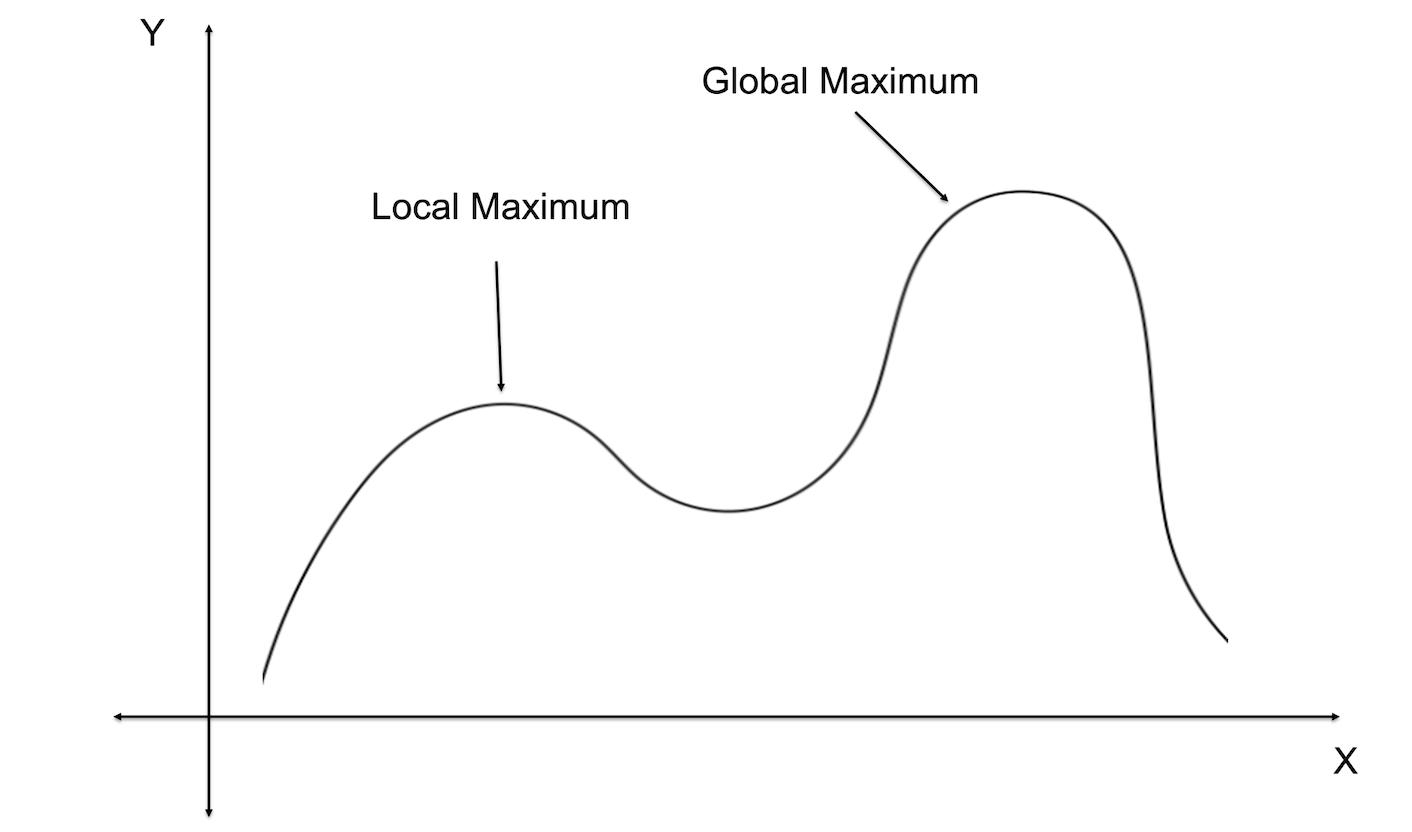
Local and global maximums are more commonly referenced in data teams and startups but the principle applies in many different contexts. In businesses we often chase optimisation of existing systems or processes even when we sense that a bigger change is needed because it is easier to do so. In life we often overvalue short term rewards and under value longer term benefits.
Chris Dixon notes that common approaches in computer science to tackle this problem may include introducing some randomness, and then reducing the randomness over time to increase your chances that you find the bigger hill. In the same way, many of us don’t have the benefit of a strong vocational purpose early in our working lives. So careers advice should perhaps be far more focused on teaching kids how to learn to find what they love doing. More experimentation, less limitation.
This principle has useful application in business strategy, running projects, in life and work. So, let me leave you with this question – are you climbing the wrong hill?
A version of this post was also published on my weekly Substack – To join our community of thousands of subscribers you can sign up to that here.
To get posts like this delivered straight to your inbox, drop your email into the box below.
Leave a Reply