
I once did a fascinating project with the operations team of a big pharma business helping them to understand how they could combine agile ways of working with Lean manufacturing techniques. As part of the research for it I did a dive into the origins and principles of the Toyota Production System (TPS) from which Lean arose, and discovered that (just like Agile) TPS is not merely a collection of tools like Just-in-Time (JIT), the five whys, or Kanban, but rather a deeply embedded mindset that has beneficial application across a far broader set of contexts than just manufacturing. This is a mindset that is really focused on:
- Continuous improvement (Kaizen): A relentless pursuit of identifying and eliminating waste (muda) and inconsistencies (mura) in every process, no matter how small.
- Respect for people: Recognising that empowered and engaged employees are the key to innovation and problem-solving, encouraging their active participation in the improvement process.
- Going to the source (Genchi Genbutsu): Physically going to the workplace to observe and understand problems firsthand, rather than relying on reports or assumptions (oh how I wish more leaders would do this).
- Building a culture of problem solving: Creating an environment where errors are seen as opportunities for learning and improvement, and employees are encouraged to stop production when a problem arises to address it immediately (jidoka).
Whilst there were some key differences between Lean and Agile which meant that context was all important in understanding the role for each, there were also some fundamental similarities in philosophy – notably challenging the status quo, fostering a culture of continuous learning and improvement, and empowering people to find innovative solutions to problems, thereby enabling the organisation to adapt and thrive in an ever-changing environment.
Understanding more about TPS also taught me a lot about transforming systems. The story of how one engineer, Taiichi Ohno, created a system that went on to change manufacturing forever is a lesson in systematically questioning assumptions, deeply observing reality, persistence and the value of intellectual curiosity.
Constraint as catalyst
After World War II, Japan’s economy was on the floor. Resources in the defeated country were extremely scarce. Toyota, a small carmaker at this time, faced an existential problem – how could they survive against American car giants like Ford and GM who were operating with massive scale and seemingly abundant capital?
At the time the accepted wisdom for manufacturing was rooted in mass production and the kind of system that Henry Ford had perfected with large inventories, long production runs, standardised products, and economies of scale. In post-war Japan that model just couldn’t work. Toyota couldn’t afford to keep huge inventories, demand was low, capital was tight, and mistakes were expensive. But despite the fact that Toyota was operating at a loss and it couldn’t afford to hire new people or purchase machinery and equipment to compete, the company’s President set an ambitious strategic goal to catch up with the Americans within three years.
Intellectual curiosity and observation
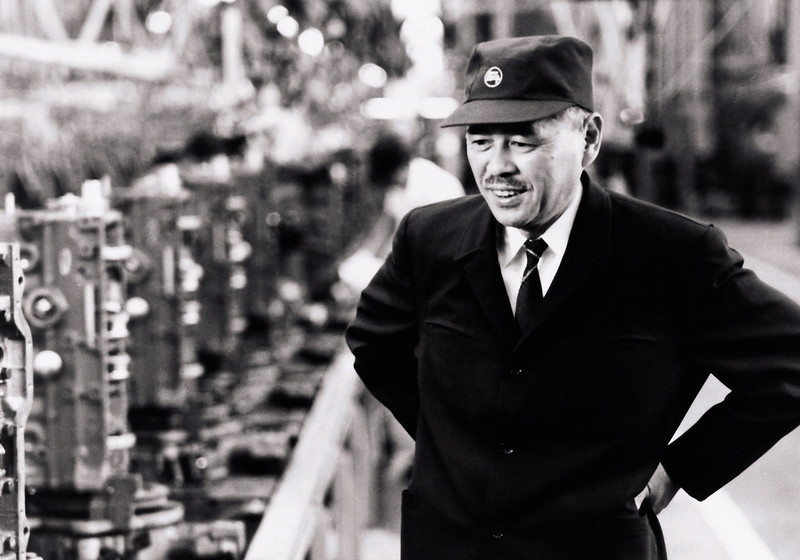
Taiichi Ohno was a relentlessly curious production engineer at Toyota who learned through deep observation. He spent hours on the factory floor with a stopwatch, watching how workers moved, how inventory piled up, and where time was being wasted. He believed problems lived in plain sight, if only people would stop to see them.
Ohno’s big insight was that waste (or muda, as he called it) was everywhere. And not just the obvious kind like excess inventory or idle machines, but also wasted movement, overproduction, waiting time, defects, and unnecessary processes. He began documenting what he later called the ‘seven wastes’ and treating them as enemies of value.
One of Ohno’s most important ideas came from a less than obvious source. In the 1950s Toyota sent Ohno to America to learn about American manufacturing techniques and he toured production facilities like those owned by the Ford Motor Company. But the American experience that influenced him the most was not a tour of a factory, but a visit to a supermarket. He was intrigued by how American supermarkets replenished goods: customers pulled what they wanted from shelves, and the store restocked based on consumption. This was the opposite of pushing goods onto shelves without knowing demand. Ohno took this principle and reimagined it as ‘Just-In-Time’ production (nothing should be made until it was needed downstream). He flipped the entire logic of production from push to pull.
The silent revolution
There’s a lot to like about how Ohno scaled the new system. He didn’t impose the TPS from the top down but instead started with one factory. He took an inclusive approach, making frontline workers part of the process and ensuring they were active problem-solvers. He created visual systems (like Kanban) that signalled when parts were needed. He reduced batch sizes. He encouraged workers to stop the production line when defects occurred – an act that would have been unthinkable in traditional mass production but which served to surface problems much earlier and improve quality.
When Ohno wanted to train managers to see inefficiencies, he would draw a chalk circle on the factory floor and ask them to stand in it for hours doing nothing but observing. Many managers found this tedious or pointless, but eventually they would start to notice small things that others had overlooked – inventory piling up unseen, workers walking too far to get a tool, or a machine sitting idle waiting for a part. It was like a fascinating kind of mindfulness practice that developed attentiveness as a leadership habit, encouraged managers to slow down and let go of assumptions, and to see waste with their own eyes, rather than relying on reports.
The idea that transformational change can start with attention and observation is a good lesson. Ohno’s system was a wholesale rethinking of how value was created and one that that redefined efficiency (flow not speed), broke the myth of scale (agility and quality trumps size and volume), shifted power to the workers (who were able to work smarter rather than harder), and institutionalised learning (every process was open to challenge and improvement).
For years, the West ignored Toyota. And then, in the 1980s, American automakers were stunned to find that Toyota produced higher-quality cars, faster, cheaper and with far fewer workers. MIT launched a study of Toyota’s methods and coined the term ‘Lean Manufacturing’ to describe it. It was a system that went on to impact healthcare, logistics, retail, construction and even financial services and government.
Yet its origin wasn’t a founder or a CEO, but one relentless engineer who had the curiosity, persistence and belief to make change happen. All power to the mavericks.
A version of this post appeared on my weekly Substack of AI and digital trends, and transformation insights. To join our community of over ten thousand subscribers you can sign up to that here.
To get posts like this delivered straight to your inbox, drop your email into the box below.
Leave a Reply