

A couple of weeks ago I ran the first IPA Advanced AI for Account Handlers course and alongside all the more obvious automations and efficiency gains from AI there were some specific techniques we focused on that have much wider application. For strategists, consultants, and anyone interested in how AI can transform managing clients and stakeholders. So I thought I’d talk about a few of them here.
The value of persistent context
Regular readers will know my enthusiasm for good knowledge architecture (rather than knowledge management) in giving better context for AI. Being intentional about giving LLMs relevant context completely transforms the quality and relevance of outputs you get out of them. As probabilistic machines LLMs will always give you average answers to general questions. And it’s thoughtful, structured prompting, and thoughtful, structured context that lifts outputs from mediocre to exceptional. So it’s a bit mystifying that so few teams seem to think about how they can establish relevant knowledge bases to inform their use of AI.
Ultimately this is going to be about bringing together knowledge and context from wherever it sits (systems, hard drives, documents, data, conversations, institutional knowledge), and orchestrating it in a way that enables relevant AI agents to access and act on it. The competitive advantage of the future is increasingly not going to come from who is using the best AI model but who has structured their organisational knowledge in ways that give those AI models all the context they need to deliver exceptional value (I’ll write more about this in the context of AI agents soon).
But for now, there’s plenty that teams can do to set up persistent knowledge bases that both humans and AI can use for decision-making. For client facing teams (like strategists, consultants and account people in agencies, or anyone that is providing an ongoing service to a client), this practice can transform the value that you’re getting from AI. Whilst I recognise that some will have the benefit of CRM systems that you can plug AI agents into to draw information from, anyone can do this. At the simplest level, setting up (secure) Sharepoint or Drive folders for each client populated with as much relevant information as possible creates a canonical ‘single source of truth’ library that AI can be draw from. Remember you’ll need to connect the AI to that folder so it can access it. Structure it logically into sub-folders and create a short ‘README’ document that sits at the top of key folders to describe what’s in there, what’s current, who owns it (AI can generate this for you once all the information is there).
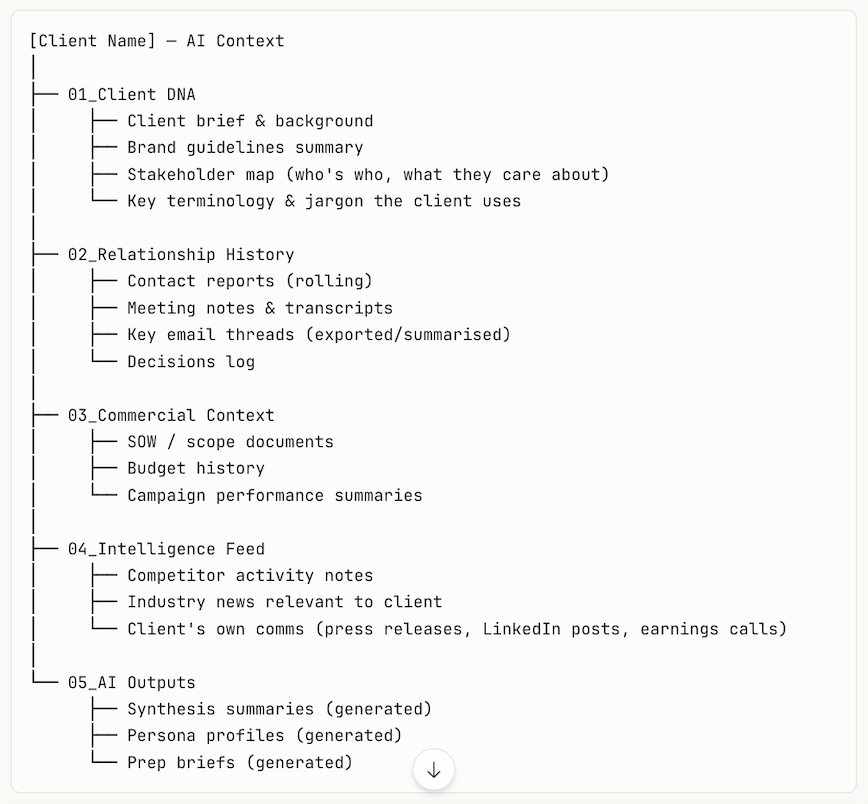
Once this is created it should be updated as often as possible with anything relevant (transcripts, automated contact reports, notes, recordings, decks, reports) to create a living client knowledge base that you can feed into any AI engine at any time. The discipline of building and maintaining it is itself valuable but once this is set up you can point the AI at relevant folders or documentation and it completely transforms the quality of outputs AI can give you for a multitude of use cases and things you may want to do for that client.
System prompts
The system prompt is a set of instructions given to an AI before a conversation starts, shaping how it responds. Like a briefing document the AI reads before every interaction. You can use it to give the AI a role, background knowledge, rules, or a specific tone, so instead of starting from scratch each time, it already knows your client, your priorities, and how to think about the work.

Your system prompt can live in your client knowledge base, but it can also be useful to directly upload it to inform client work you may be doing, and to provide instructions for Project Spaces. Spaces are hugely valuable for working on individual ongoing projects because you can come back to them repeatedly and structure multiple conversations around different needs like research, data analysis, plan formulation, creative thinking. The system prompts I’ve created before now in work with agencies include a brief description of who you are, the role you need the AI to play, a couple of paragraphs on the client, a few more on market and competitive contexts, a brief description of each key stakeholder at the client and their decision-making and communication preferences, five bullets on relationship history and any key sensitivities, a short list of the current strategic client priorities, and then a paragraph on how you’d like the AI to use the context you’re giving it.
Again, using a system prompt completely transforms the work you’re able to do with the AI making it far more relevant and valuable. What you find (particularly when using it in a Claude Project) is that without needing to ask it, the AI will frame ideas or plans or perspectives in ways that reference specific angles or data points from the system prompt. It even uses the persona details in the system prompt to give you angles for how you should present an idea to different stakeholders or objections they may have.
Using synthetic client personas
Which brings me to client synthetic personas. I’m a big fan of using synthetic personas to open up new perspectives and potential pathways to explore. They should not be a direct substitute for human research but used in the right way they can open up new lines of thinking, help you to generate hypotheses that can be tested, or consider a complex challenge from new or different angles. So whilst synthetic client personas can’t be a direct substitute for the empathy and unique client understanding that only an experienced client relationship manager can have, they can be so useful in all kinds of ways, giving you a whole new toolset to take the management of multiple stakeholders to a different level.
To generate good client personas it can be useful to begin with some client relationship history and the past interactions and sensitivities that can help a persona behave like your actual client. Defining each stakeholder’s decision-making lens, for example what data, values, or pressures drive how they evaluate recommendations and ideas. You can build in key tensions, preferred communication styles, and then include other relevant concerns that they may be focused on like competitive threats, dealing with other client stakeholders, internal politics, which helps the persona to respond situationally.
They can be useful for a whole range of use cases such as recommending the right angle to pitch an idea to make sure it lands, rehearsing pitches and defining potential questions or objections you may get, stress-testing or sharpening arguments, preparing for difficult conversations, experimenting with different angles, and simply helping a team to align and build a shared understanding of a stakeholder’s priorities before you walk into the room.
The personas can live in your persistent knowledge base, or you can use them in specific tasks, but what you’ll find is that the AI will reference specific stakeholder angles, likely feedback, potential objections, or tweaks to plans and ideas based on the personas. And it does this in a way that is embedded within the work that you’re already doing with the AI, often flagging potential issues without you needing to ask. This is particularly useful when you’ve built a range of personas for the same client and need a recommended common angle but also stakeholder-specific slants.
So there you have it. The usefulness of knowledge bases, system prompts, and client personas compounds when they are brought together. It’s a system. When you put these techniques alongside the current focus on task automation and efficiency the value that AI can bring runs a lot deeper. None of them is transformative on its own. But as a connected system, they shift AI from a general-purpose tool into something that actually understands your client, your relationship, and what’s at stake.
A version of this post appeared on my weekly Substack of AI and digital trends, and transformation insights. To join our community of over thirteen thousand subscribers you can sign up to that here.
To get posts like this delivered straight to your inbox, drop your email into the box below.
Leave a Reply