
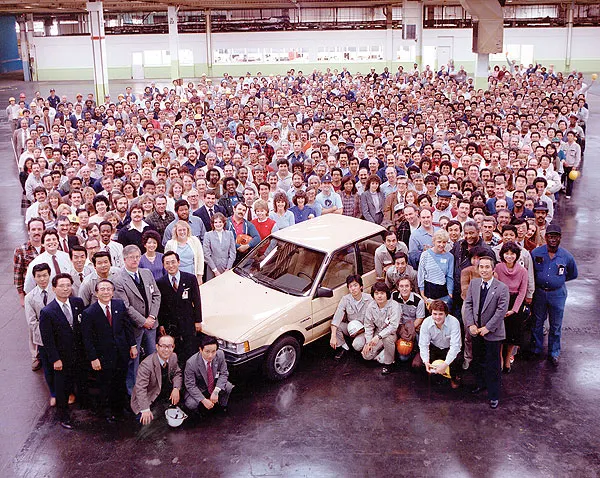
By the early 1980s the General Motors assembly plant in Fremont California was widely regarded to be the worst performing car manufacturing site in the U.S. The company had a huge employee engagement problem with absenteeism regularly running at over 20%, and sometimes approaching 50% on a Monday. When managers had too few people turn up to start the production line it was said that they would walk across the road to the bar and bring drinkers over to fill the gaps. Staff grievances piled up en masse, with some employees ending up despising management so much that they would sabotage the cars they were building. In 1982 General Motors had had enough and they closed the whole plant, laying off around five thousand people.
At the time General Motors was struggling to compete with the competitive challenge from Japanese manufacturers like Toyota. American buyers were drifting towards Japanese imports in sufficient numbers that Congress was considering trade restrictions. GM had become aware of Toyota’s revolutionary production system for manufacturing high-quality cars in highly efficient ways but they still didn’t know how to build smaller, fuel-efficient cars profitably. The company’s desire to fill the small-car gap combined with Toyota’s need to establish a manufacturing foothold in the U.S. ahead of those proposed tariffs, led in 1984 to the two competitors forming the New United Motor Manufacturing Inc (NUMMI), a 50/50 joint venture to build cars in California again.
The union insisted that NUMMI rehired the old Fremont workforce. GM resisted, but Toyota agreed, betting that the old problems could be turned around and 85% of the new workforce was derived of previously fired GM Fremont workers. On the face of it this looked like a disaster waiting to happen but Toyota held the belief that the fault for the previous problems lay with the GM system, not the workers themselves. They set about re-training the workers, flying the entire workforce in groups of 30 to Toyota’s Takaoka plant in Japan and having them work alongside experienced Japanese teams.
The U.S. workers, used to a combative shop floor environment, experienced a very different way of working. They saw first hand how Japanese production workers took individual responsibility for removing inefficiences from the system. Workers were treated as adults with real responsibility and authority. The workforce was organised into small teams and roles were rotated to alleviate monotony. Kaizen (continuous incremental improvement) enabled everyone to own quality control. Individual workers were expected to suggest improvements and the company paid small bonuses for good ideas that helped efficiency or quality. In Japan, when someone on the line fell behind, rather than getting shouted at by management, their co-workers would step forwards and offer to help. The andon cord (the rope that ran the length of the production line which any worker could pull to stop the line when they spotted a problem) became a recognisable symbol of a new, empowered culture of work. At GM the cardinal rule had been to never stop the line, regardless of the cost involved, meaning that defects went unresolved and created bigger downstream problems. The same people that once sabotaged the cars they were working on began to take pride in the quality of their work.
Within three months of the plant opening the cars coming off the NUMMI line were achieving near perfect quality ratings and defect scores that were amongst the lowest in the country. Absenteeism fell from over 20% to a steady 2%. By 1986 NUMMI was the most productive plant in GM’s network of factories (one study even found that the old system would have required 50% more workers to produce the same car). The worst workforce in America had become one of the best. The people hadn’t changed but the system had.
NUMMI is often used as a lesson in transforming systems and behaviour but there is another, much less talked about, lesson which has unique relevance to modern-day AI transformation challenges. The NUMMI plant ran until 2010 when GM went bankrupt and was bailed out, and Toyota decided to close the site. It had given GM the most valuable management lesson in its history but the GM leadership had singularly failed to scale it. They failed to appreciate that much of the knowledge and ritual that NUMMI brought to the company was based on a culture and tacit understanding that had been built up through habits and behaviours over years of practice. When GM tried to copy the andon cord idea to its Van Nuys plant the underlying culture was not there to support its effective use and it added no value. The company dispersed the few people who carried the new practices with them back into a system which punished those very practices. The NUMMI culture was never allowed to reach critical mass and it withered and died.
In virtually every company I’ve worked with on AI capability and transformation, I’ve come across AI-superusers who understand not only the functionality of the tools but who also have a unique sense of how humans can work with AI to get the most from the machine. You can find them in almost every team. They’re the people that use AI for generative expansion or adversarial challenge of ideas to reveal the options, angles or questions that they haven’t considered, rather than just use it as an answer engine. This way of working is like the andon cord for thinking – a willingness to stop the line and go deeper on a defect or anomaly rather than let it pass downstream. They’re willing to use AI to explore new territory rather than bringing it finished questions. They’ve developed a systematic way of working with AI that compounds over time and makes good use cases far easier to spot and scale locally.
Many leaders seem to be taking a very functional, practical approach to raising AI fluency and there is undoubted value in staff understanding how to use the tools. But there is also a real difference between functional knowledge and the kind of intuitive understanding that can dramatically reinforce and multiply the value teams can get from AI. Often this tacit knowledge already exists within the company but capability does not transfer through exposure. A successful pilot stays as a successful pilot. The organisation’s incentives, power structures and sense of identity is not welcoming of new ideas and deep but isolated understanding stays isolated. This is the top-down fantasy, bottom-up trap writ large. It’s the innovation execution gap repeated again and again across an organisation. It’s a failure to cross the chasm of culture change from the early adopters to the early majority.

When I wrote about how the classic diffusion of innovations curve and the related ‘crossing the chasm’ concept is so often misinterpreted, I described how many assume that the challenge in achieving scale lies in convincing more people to adopt the technology. In reality, crossing the chasm from early adopters to the early and then late majority is about solutions that address specific, widely understood problems and that resonate with the pragmatism of the early majority. Novel (or ‘discontinuous’) innovations like AI require new behaviours, experiences and learning rather than simple refinements or incremental shifts in existing practices.
Diffusion of AI capability is a separate, deliberate, and resourced act where tacit knowledge needs to combine with explicit knowledge through people, immersion and time. Empowerment has to be real, not announced, and culture changes through experience rather than instruction. The early adopters can be critical catalysts for change but only if behaviour change is enabled to reach critical mass.
For 25 years, GM held the key to a totally different way of working that could enable unprecedented efficiency but they failed to use it. The workers at NUMMI were to GM what the modern day AI early adopters are to any business that is lucky enough to have them. They need to be deliberately protected from the white blood cells of organisational inertia so that they can build the density and cover that can actually change a culture rather than be swallowed by it.
A version of this post appeared on my weekly Substack of AI and digital trends, and transformation insights. To join our community of over thirteen thousand subscribers you can sign up to that here.
To get posts like this delivered straight to your inbox, drop your email into the box below.
Leave a Reply